Duchesse de Nemours Peony Bloom Size and Flower Form
Six to eight inches across. That is the width of a mature Duchesse de Nemours flower head, and it is the number we give every customer who asks. One customer sent us a photo of her first bloom after three patient springs, a white ball sitting in her palm with a ruler laid across it. She wanted to know whether the plant was normal. It was.
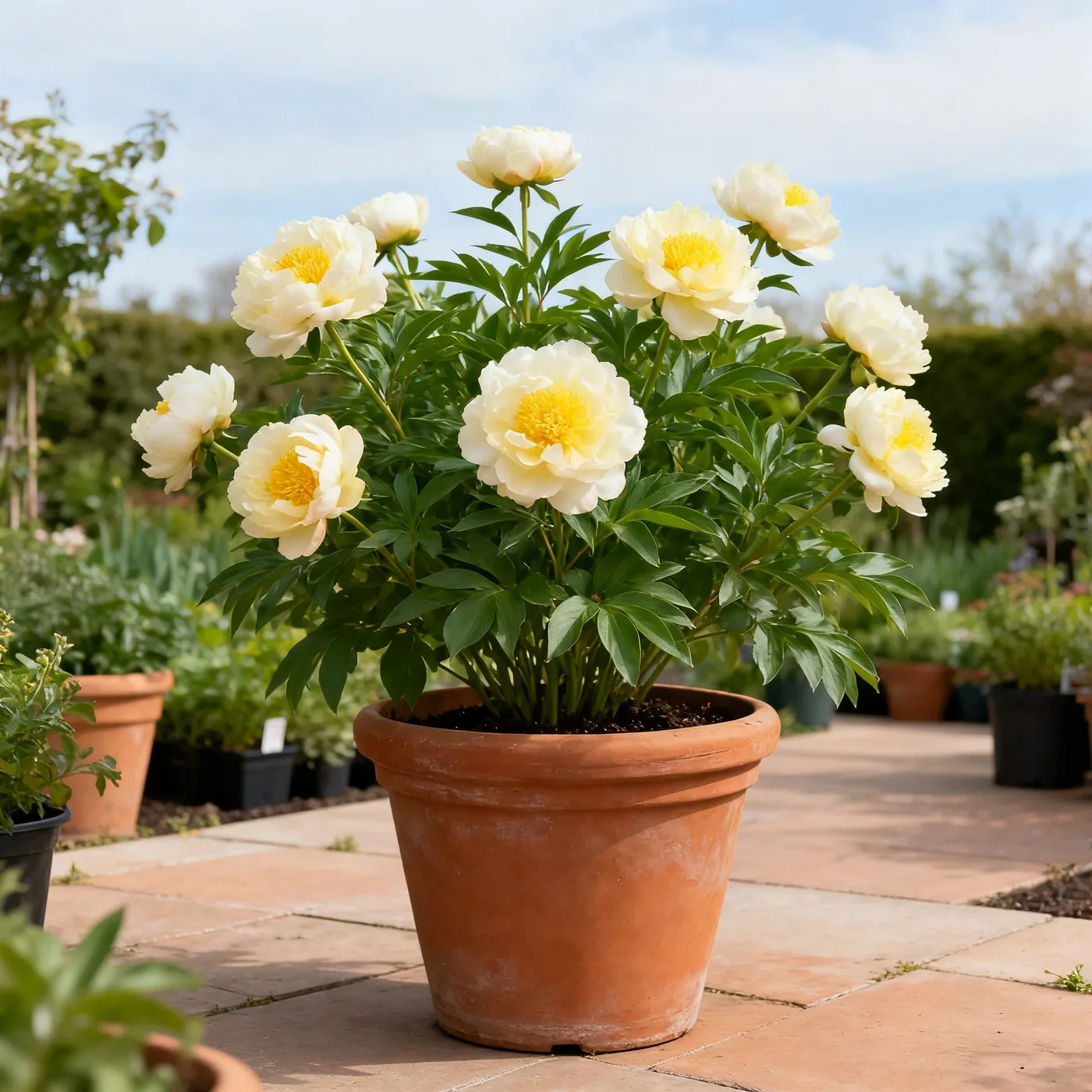
Flower size is the reason most people plant this peony and the thing they are least able to judge before it opens. Crowd the clump, shade it, or let every side bud run, and the head comes in smaller and looser than it should. Get the conditions right and a single flower fills a vase.
Below, you'll find out all about the size and shape of the flower itself, including how far the white carries across a garden, how many heads each stem holds, how wide a bloom opens, what a bomb-type form is, how to count petals, and how to measure your own plant.
The Border Where Blooms Read From Across the Lawn
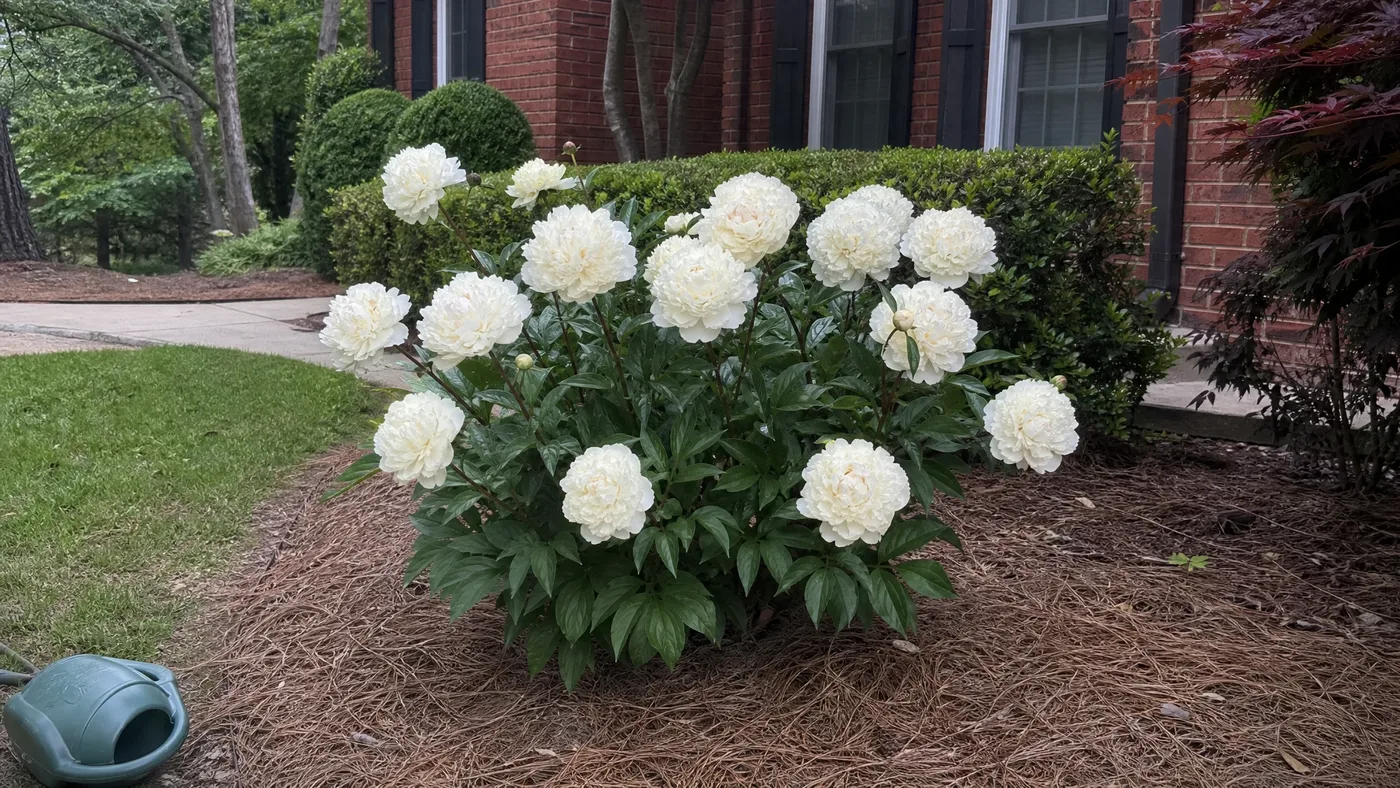
Start with the wide view. A white head 6 to 8 inches across is large enough to register as a pale dome from the far side of a lawn, but only against the right backdrop. The flowers are fragrant, fully double and white, at about 6 to 8 inches across, and that white needs contrast to carry. Pale siding or a light wall swallows it. Dark evergreen, a stained fence or a clipped hedge holds it up.
The plant itself is modest. Height and spread run roughly 20 to 40 inches, so the flowers sit on a mid-height mound, not a tall spire. Our size and spread guide covers the plant dimensions in full. Here the point is simpler: the head is big relative to the clump that carries it.
Choose the Backdrop First
Walk to the spot you are considering and look back at the house or the far fence line. Whatever stands behind the clump is what the flowers will be read against. Dark green is the best partner. Bare soil and mulch also work in the first years, when the clump is small and the heads sit low. Skip silver or pale gray foliage directly behind the plant, because white on pale gray loses its edge.
Plant in Groups for Distance
Set three clumps in a loose group rather than one in a row. Three heads opening together make a white mass that reads at distance, while a single clump reads as one flower. Bloom runs late spring to early summer, and NC State Extension's peony profile puts flowering at about two weeks per plant. Plan the border so the group is the main event during that window. Our bloom time and color guide has the calendar.
Judge the border at dusk. White heads hold their shape in low light long after colored flowers go dark.
Duchesse de Nemours Peony Stems and Their Flower Count
Now move in to the plant. Each stem grows a large terminal bud at the tip and usually a few smaller side buds along the upper leaf joints. Left alone, a stem opens several heads, and the side flowers come in smaller than the top one. The terminal bud is the showpiece. Everything else supports it.
We have no sourced figure for heads per stem or per clump, and we will not invent one. The count depends on clump age, sun and how you treat the buds. Count your own in spring, once the buds show color at the tips. A young plant may carry only a handful of stems. A clump left undisturbed for many seasons carries far more. Herbaceous peonies grow slowly, so expect the count to rise gradually over years.
Disbud for One Big Head
Choose your goal before the buds swell. For the largest single flower, pinch off the side buds while they are small. Use your thumbnail and snap each one cleanly at the stem. The stem then sends its energy to the terminal bud. For a fuller garden show with more, smaller flowers, leave every bud in place.
Disbud only the stems you plan to cut and leave the rest of the clump alone. You get a few exhibition heads for the house and a full display outdoors.
Support the Weight
A fully double head soaks up rain and bends the stem toward the ground. Set a ring or grow-through support over the crown in early spring, when shoots are only a few inches tall. Fitting it later breaks stems and bruises buds. The support should be hidden by foliage by the time buds form, so the flowers look free-standing from across the lawn.
Reading the Buds
Buds tell you what the bloom will do. A terminal bud that swells round and firm is on track. A bud that stays small and hard, or turns brown before it opens, points to frost damage, drought or a problem with the roots. Our guide to peonies that will not bloom walks through those causes in order.
Flower Head Diameter on Duchesse de Nemours Peony
The usual figure is about 6 to 8 inches. Some listings quote smaller numbers, and heads on young plants often open under the range. Treat 6 to 8 inches as the target for a mature, well-sited clump with a terminal bud, and treat a smaller head on a young plant as normal, not a fault. The first bloom is rarely the biggest the plant will ever make.
Several things move the number. The table below lists the main ones and which direction each pushes.
| Factor | Effect on diameter | What to do |
|---|---|---|
| Disbudding | Larger terminal head | Pinch side buds while small |
| Clump age | Young plants open smaller | Leave the clump undisturbed |
| Light | Shade gives fewer, smaller heads | Give full sun or light shade |
| Moisture at bud stage | Dry spells shrink buds | Water deeply in spring dry spells |
| Crowding | Competing roots cut size | Keep neighbors back from the crown |
Light Matters Most
Sun matters more than most people expect. NC State notes that peonies do well in full sun to light shade. Aim for the bright end of that range. Our sun requirements guide explains how to judge a site. Light shade keeps the plant alive and flowering. Full sun is what pushes the head toward the top of the size range.
Age and Patience
Growth is slow, so diameter climbs over several seasons as the root system fills in. A plant moved or divided drops back for a year or more. If you want the full 6 to 8 inches, plant once, site it well and leave it alone. If your heads fall well short after several years, look at light and crowding before anything else.
The Bomb Form Inside One Flower
Duchesse de Nemours is fully double, and within the double group its shape is the bomb type. A bomb has a distinct, rounded center mound of small petals, raised above a collar of wider outer petals. From the side the flower looks like a ball sitting in a skirt. The center is dense enough that you do not see stamens in a fully open head.
How Bomb Differs From Other Doubles
A semi-double shows a ring of golden stamens between its petal layers. A Japanese form carries a tuft of narrow, modified filaments in the middle. A single has one row of broad petals around an open center of stamens. A rose-type double fills its center fully but flattens into a more even, layered cup, without the raised mound. Bomb is the one that stacks high.
Fully double does not mean identical to every other double white. Our comparison with Festiva Maxima shows how two white doubles differ in shape and detail. This cultivar is also fragrant, which is a trait you notice before you see the form.
What the Form Costs You
A dense center holds water. Rain pools in the layers and the head sags, and a wet bloom can brown at the edges. Cut stems on a dry morning if rain is coming, and bring them indoors where the form can open fully. A single or semi-double sheds water far better. The bomb trades that toughness for fullness, and in our view the trade is worth making.
Counting Petals in a Duchesse de Nemours Peony Bloom
A mature head carries dozens of petals. We have no published exact count to give you, and counts vary from flower to flower on the same plant. Count your own and use that number. The structure, from outside in, is consistent.
Outer Guard Petals
The outermost ring is the guard petals. These are the broadest, flattest petals, and they form the collar of the flower. They often show the cleanest white. There are only a few, and they usually sit in one or two rows. Their job is to hold the rest of the head in shape as it opens.
Middle Layers and the Center
Inside the guard ring, petals shrink in width and fold more tightly with each layer. The middle ranks are ruffled and overlap heavily. At the center, petals are small, cupped and tightly packed, and they open last. A creamy tint at the very center is common in the youngest layers and fades as they expand.
How to Count Without Losing Track
Count after the bloom is spent, never on a flower you plan to cut. Pull petals off one ring at a time and lay them in rows of ten. Do the guard petals first, then each layer inward. A head that is still opening gives a low count, so wait until it is fully open. Round small center petals into a single tally if they are too tight to separate.
Measuring Your Own Duchesse de Nemours Peony Flowers
Use a ruler, a notebook and one fully open flower. Do the measuring at the same point in the bloom each year so the numbers compare.
Measure the Diameter
Wait until the outer guard petals have stopped moving. Hold a ruler across the widest point of the head, tip to tip of opposite guard petals. Do not press the petals flat. Take two readings at right angles and average them. Compare the result with the 6 to 8 inch range, and note how far off you are.
Count and Record
Pick one terminal flower and one side flower from the same stem if you can, since the two differ in size. Note the stem, the date, the weather and whether you disbudded. Record the petal count by ring. This makes the notebook useful years later.
We often see customers measure once, get a small number in a young plant's first year, and worry. Three seasons of notes tell the story far better than one reading.
What Your Duchesse de Nemours Flowers Tell You
A mature head runs about 6 to 8 inches across, opens as a bomb with a raised center, and layers dozens of white petals from broad guard petals to a tight core. Light, age, moisture and disbudding are the levers. Your own measurements beat any published average, so keep a record. Use this routine each spring:
- Measure the open head across its widest point and average two readings.
- Count the petals ring by ring after the bloom fades.
- Record the date, stem and whether you disbudded.
- Repeat next year and compare.
Duchesse de Nemours Peony
Nursery-grown Duchesse de Nemours Peony in sizes from 2 Gallon, shipped to your door.
From $69.95
Shop Now →Duchesse de Nemours gets a spot in full sun with well-drained soil in our fields, and our own growers raise and pack each top-quality peony from start to finish. Seeing how a full, creamy bomb of a flower opens makes us want to put one in your yard as well, so if you would like to see those layered white petals for yourself, pick out a Duchesse de Nemours for your garden.