Is Your Duchesse de Nemours Peony True to Name?
Lean into an open Duchesse de Nemours on a morning in peony season and your nose finds something a plain white flower isn't supposed to have. People expect a crisp, clean, scentless sort of white. This old peony gives you a heavy, fragrant globe with a soft warmth at its heart.
That is the plant on paper. The plant on a tag is another matter. Calot registered this cultivar in France in 1856, and about 170 years of dividing, sharing and reselling have given look-alike old white doubles plenty of chances to slip in under its name.
This article talks about scent, color, form, the flower's center and bloom timing, and answers the questions customers ask us most. Read on to learn what a true bloom looks like, what can throw it off, and what a real mismatch tells you.
When Your Duchesse de Nemours Peony Smells Like Heaven
Bend into an open flower on a warm morning, once the dew has lifted, and the scent reaches you before your face reaches the petals. Duchesse de Nemours is a notably fragrant flower. This is the first check we ask you to make, and it costs nothing.
How to Smell It Fairly
Give the test the best conditions you can. Choose a flower that opened a day or two ago, not a tight bud and not a tired one, and smell it in the warmth of mid-morning rather than at dawn or in a cold wind. Better still, cut one, stand it in a vase indoors and come back in an hour. A still room holds perfume close, and a single stem can scent a whole kitchen.
What a Weak Scent Can Mean
A faint scent does not condemn a plant. Tight buds hold their perfume back, cold mornings mute it, and a bloom that has sat through a day of rain smells washed out. A young plant carrying one or two flowers can seem shy as well. Come back on a warm, dry morning before you judge it.
If the scent stays thin across several flowers and several days, keep that in mind as you read on. It is a hint, and the other traits below will tell you whether it means anything.
Why Scent Alone Cannot Settle It
You will hear that a good nose can identify an old peony. We would not rely on it. Festiva Maxima is fairly fragrant and Marie Lemoine richly fragrant, so two of the usual look-alikes smell good as well. Treat scent as a first filter that tells you the plant is probably in the right company. Our scent guide goes deeper on what to expect.
Petals That Look Pink or Creamy Instead of White
A flower on its third day, ivory at the edges, makes plenty of people suspect the tag. One of the most common questions we get is whether a cream-colored bloom means the wrong plant. Usually it does not, and the first thing to look at is the age of the flower.
Bloom Age and Light
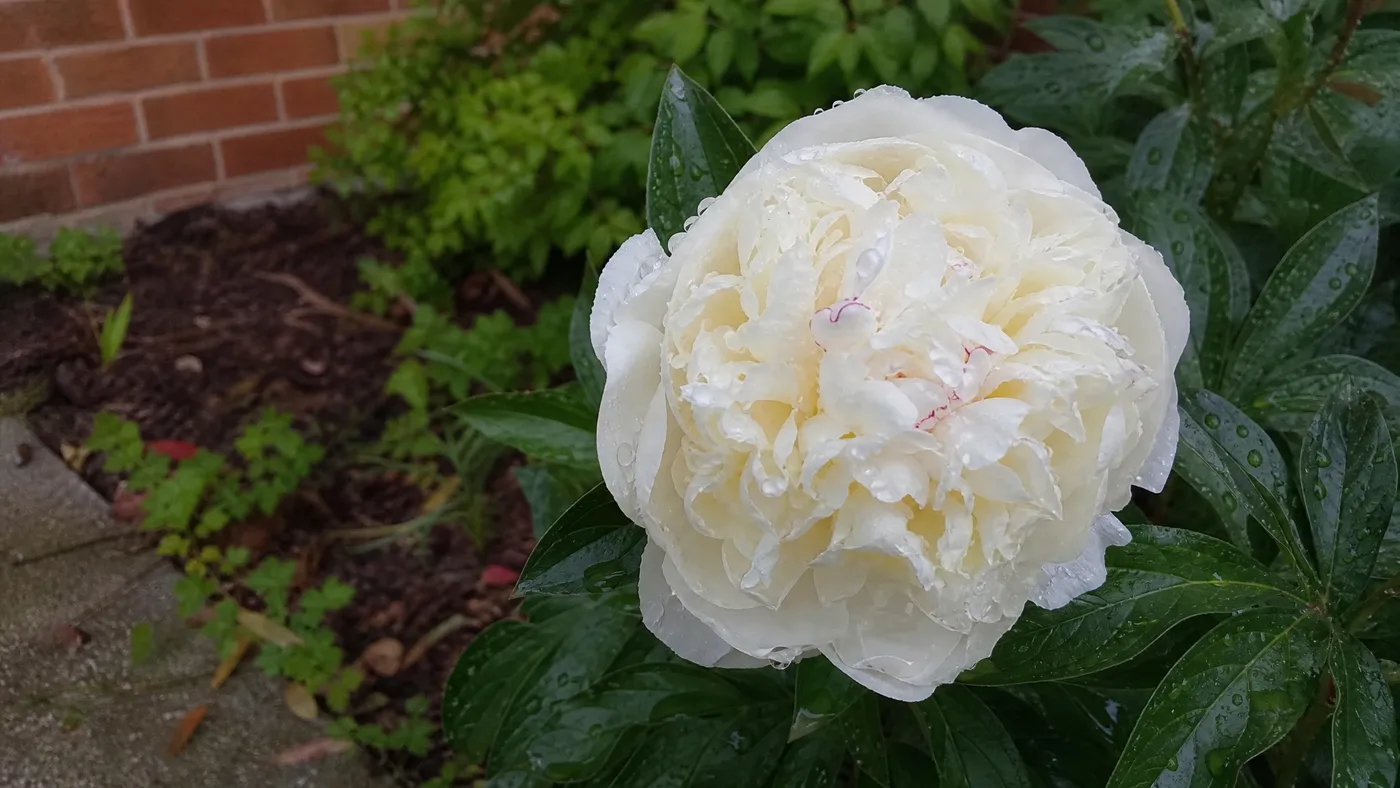
The flower has white guard petals around a center of light canary-yellow. As a bloom ages, the white softens toward ivory and the warm heart seems to spread outward. Judge color on day one or two of a flower, never on a tired one.
Light changes the picture too. This cultivar does well in full sun to partial shade, and a flower in open sun can look brighter at noon and creamier by evening. Photograph your plant at the same hour on two different days before you compare it to anything. Our sun requirements guide covers how site light shapes the plant.
Reading Color Honestly
Phone cameras are poor judges of white. Many of them warm up a pale flower or cool it down depending on the background, so a picture taken against green foliage can look pinker or yellower than the flower really is. Hold a sheet of plain white paper behind a fresh bloom and look with your own eyes, in shade or in even light, not in low evening sun.
When Color Points to Another Plant
Clear pink in a fresh, newly opened flower is not this cultivar, however many days you wait. A strong yellow wash over the whole flower points toward Marie Lemoine, which is strongly suffused with yellow from hidden stamens and staminodes. Our bloom time and flower color guide shows the range a true plant can pass through.
Duchesse de Nemours Peony Blooms Open Flat, Not Rounded
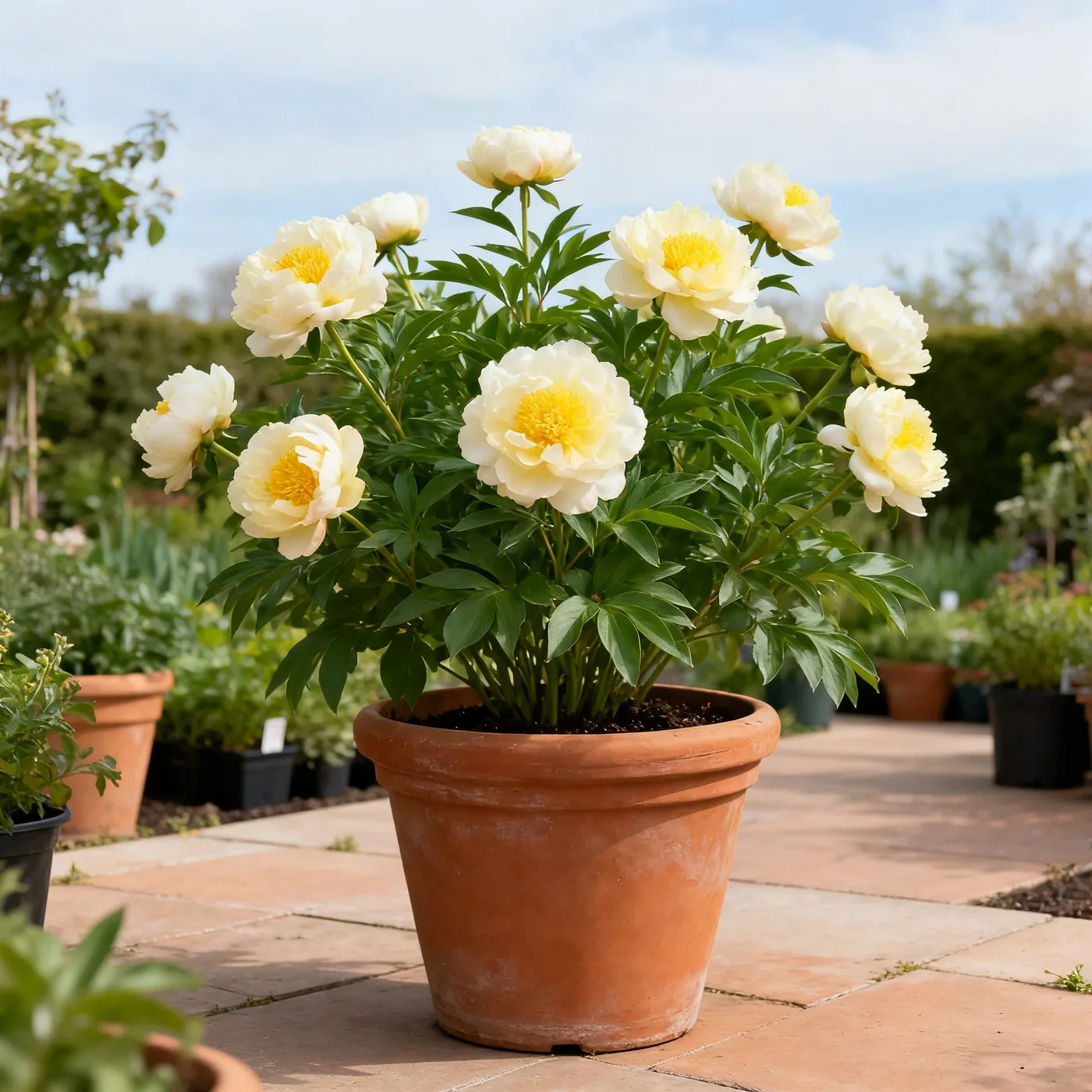
Picture a flower that opens like a saucer, with the center spread wide and no cup left to it. That is not this flower. The general impression of Duchesse de Nemours is a rounded, flattish globe, with cupped guard petals, and the flowers are fully double, white and about 6–8 inches across.
Note the word flattish. A true bloom relaxes as it ages, and an open flower on its second or third day will sit lower than it did on day one. What should worry you is a flower that is flat from its first hour, thin in the middle, or shows its stamens in an open ring.
Causes and Fixes
Young plants are the most common reason. The first flowers on a new division are often simpler and looser than the mature plant will give you, and they improve over the following seasons. Shade does it too, because a plant reaching for light makes thin growth and thinner flowers. If your plant sits in deep shade, moving it in fall is a better fix than any feeding.
Weather matters as well. Heavy rain flattens even a good double and leaves the petals plastered together, so cut flowers before a storm if you can and let them open in the house. A flower that has been rained on and then dried in the sun often recovers some of its shape, so never judge form on a single stormy day.
When Flat Is the Answer
Where the form never improves, remember that Marie Lemoine is described as compact and flat at first. A plant that opens flat every year, with a yellow cast, is worth a second look. Flat form alone is not proof, but flat form with yellow suffusion and a late bloom is a strong case.
A Faint Blush Center That Never Shows Up
Look into a fresh Duchesse de Nemours and you should find a heart that is warmer than the guard petals around it. The center is moderately full and light canary-yellow, deepening to pale green at the base of the petals. In our rows, that reads as a faint blush or soft cream against the white, and it fades to cream as the flower ages.
Fading is the normal story, so a center that goes pale by day three tells you nothing. A center that is stark white from the first morning, with no warmth at all, is a different matter. So is a center that is strongly yellow rather than faintly warm.
Check the Green
The most reliable private check is at the base of the flower. Fewkes wrote of it: "A distinctive characteristic of this flower is its green carpels and stigmas." Part the center petals gently on a fresh bloom and look down. Green at the base of the petals and green carpels are the kind of detail a mislabeled plant rarely matches.
What the Center Tells You
Think of the center as the signature of the flower. The guard petals can be changed by light, age and weather, but the arrangement at the heart is much harder to fake. A true plant gives you a modest, warm center that is moderately full, with green beneath it. A plant with a heavy cream or yellow mass, or with nothing warm at all, is showing you something else. Take a photo of a fresh center each spring so you can compare year to year.
Flowers Arriving Early or Late for Duchesse de Nemours Peony
Your neighbor's peonies opened a week ago and yours are still in bud, so you wonder if yours is the wrong plant. Timing is a real clue, but only against the right yardstick. Duchesse de Nemours is an early bloomer, and Marie Lemoine is a late one.
That gives you a useful test. A white double that opens well behind the early peonies in your own garden leans toward Marie Lemoine, not Duchesse. A white double that opens with the first group is at least consistent with Duchesse de Nemours.
Judge by Neighbors, Not the Calendar
Bloom date shifts with climate, so we cannot give you a date that holds in every yard. North Carolina State Extension says herbaceous peonies bloom from late spring to early summer, with about two weeks of bloom per plant. Compare your plant to other peonies growing near it across two or three springs, and note which opens first. A notebook kept by the back door beats memory every time.
Young Plants Run Late and Look Odd
Peonies are slow growers, and a newly planted division often flowers later and more sparingly than an established clump. Do not read a late first bloom as a wrong plant. Wait until the plant has settled in, then judge timing from its second or third full spring. A warm spell can pull the whole bloom period forward and a cold one can stretch it out, so one odd year proves nothing.
Red Flecks, Single Petals, or Odd Colors
A few crimson flakes on the central petals of an otherwise white flower is the clearest mismatch most customers ever find. Festiva Maxima is white with prominent crimson flakes on a few central petals, and it is the plant most often confused with ours. Our Festiva Maxima comparison sets the two side by side.
The table below turns what you see into a likely answer.
| What You See | What It Suggests |
|---|---|
| Prominent crimson flakes on a few central petals | Festiva Maxima |
| Trace of crimson on petal edges, strong yellow wash, flat at first, late bloom | Marie Lemoine |
| Single or semi-double flowers | Not Duchesse de Nemours, which is fully double |
| Clear pink or red petals | A different plant altogether |
Singles and Semi-Doubles
A single flower deserves a note of its own. This cultivar is fully double, so a single bloom is not a matter of age or weather. If you see one, the label is wrong or something else has taken over the clump.
Inherited and Divided Clumps
Plants passed along from a neighbor or a grandmother's border are where mix-ups hide. Divisions get shared, tags get lost, and two clumps planted side by side can grow together over the years. If one plant throws flowers of two kinds, you are probably looking at a mixed clump, and the sensible move is to note which flowers match the traits above before you divide anything.
Trusting What Your Duchesse de Nemours Peony Shows You
A true plant gives you a set of traits that agree with each other. It is notably fragrant, white with a soft, warm heart, a rounded and slightly flattened globe about 6–8 inches across, with green carpels and stigmas, and it opens early rather than late. One trait off is usually weather, age or a young plant. Three or four off is a different cultivar, and you should write to the seller with photos from two springs. Our buying guide covers crown health, which is a separate question from identity.
Duchesse de Nemours Peony
Nursery-grown Duchesse de Nemours Peony in sizes from 2 Gallon, shipped to your door.
From $69.95
Shop Now →Duchesse de Nemours does best in full sun and well-drained soil, and that is how we raise it on our farms. We grow and sell top-quality plants as a small business, so what we send you is the plant we would want to compare against your own. When you are ready to plant a peony you can trust to be true to name, take a look at our shop.